Reviewed · TOURS
Giudecca Island Discovery Tour
Giudecca is where Venice lets its hair down. Across the water from the grand palaces and packed lanes, this long island shows another side of the city: former flour mills, working spaces, quiet courtyards, artists’ studios, and views toward San Marco. I especially like the way the tour connects the island’s past as a place of exile and industry with its newer creative life. I also like that local guide Valerio, along with guides such as Genny, brings personal Venetian knowledge rather than offering only the usual postcard facts.
The main drawback is value. At $163.64 per person for about two hours, this is a costly walking tour, and your water bus ticket to Giudecca is extra. The small group and local access help justify the price, but you should choose it for its unusual subject and guide-led interpretation, not simply for the number of sights.
- Giudecca beyond the postcard: See the parts of Venice most people pass by from a vaporetto.
- A local story of change: Learn how the island shifted from aristocratic exile to industry and then toward art and design.
- Palladio’s Redentore: Visit one of Venice’s most important churches and hear about the annual bridge pilgrimage.
- Former factories reborn: Follow the change from the Molino Stucky flour mill and glass production to hotels, homes, theaters, and studios.
- Small-group walking: The group is limited to 10 people, and some departures may feel almost private.
- A scenic finish: End near the Zitelle water bus stop with views toward San Marco and Punta della Salute.
Why Giudecca is worth two hours of your Venice time
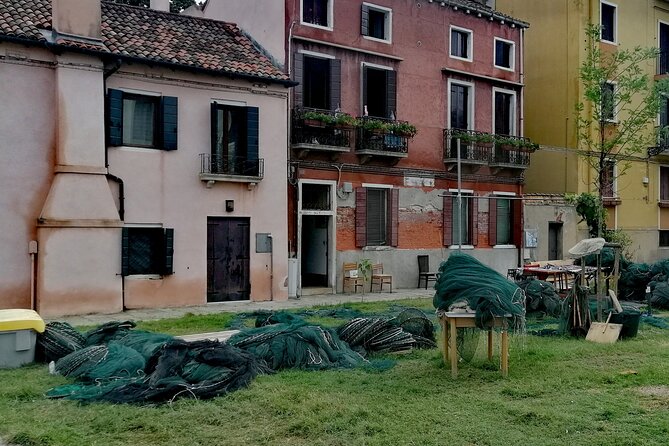
Most people see Giudecca from the vaporetto. Its long waterfront sits in plain sight, but the island’s interior is easy to overlook. That is exactly what gives this walk its purpose. You are not checking off Venice’s headline sights. You are learning how an island changed as the city around it changed.
The tour begins near the Zattere, on the southern edge of central Venice. From there, you cross to Giudecca by water bus, with the ticket purchased separately on board. The ride is short enough that it feels like a simple local connection rather than a separate excursion, but you need to allow time to find the correct stop and board before the walking portion begins.
The group limit of 10 matters here. Giudecca’s lanes, courtyards, and former industrial spaces are not designed for large tour parties. A small group also gives you room to ask questions. One booking even turned into a private experience, which made it easier to discuss food, neighborhoods, and daily Venetian life with the guide.
The island’s name and its long history of outsiders
The opening story concerns the name Giudecca. The tour explains that it is not based on the Italian word for Jewish people, despite the similarity. Instead, it is linked to the Venetian term zudega, meaning the judged, and to aristocratic families who were banished to the island after rebelling in the ninth century.
That detail sets the tone. Giudecca has long been a place slightly outside the city’s center, used by people and activities that did not fit neatly into Venice’s public face. First came banished nobles. Later came industry. In more recent years, artists were drawn by the large, unused spaces left behind when industrial activity declined and rents in central Venice became harder to afford.
I like this opening because it gives you a useful way to read the island. A rough wall, an old warehouse, or a quiet courtyard is not simply an attractive backdrop. It may be part of a much longer cycle of exclusion, work, abandonment, and reuse.
Other Venice outings people book alongside this one:
- Venice: Doge’s Palace Reserved Entry Ticket
★ 4.6 · 42,716 reviews - Venice: Grand Canal Gondola Ride with App Commentary
★ 4.1 · 18,908 reviews - Boat Trip: Glimpse of Murano, Torcello & Burano Islands
★ 4.3 · 15,699 reviews
Sant’Eufemia and the island’s oldest religious layer
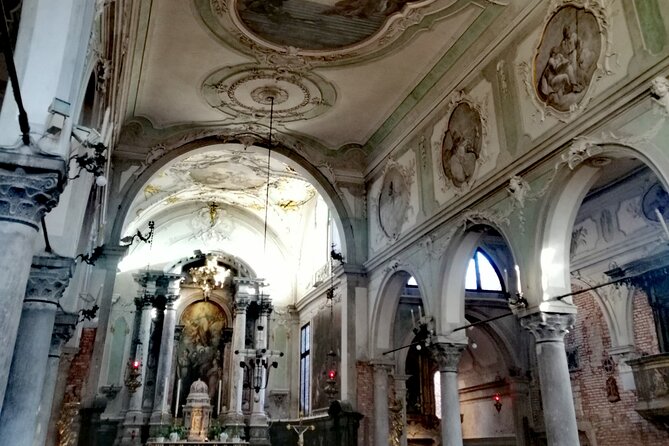
At Fondamenta Sant’Eufemia, you visit a church with origins dating to AD 890 and a simple Veneto-Byzantine structure associated with the fourteenth century. Its dedication is to Saint Euphemia, a Byzantine Christian martyr.
The story attached to the saint is dramatic. According to the tradition explained on the walk, she was thrown to hungry lions, but the animals bit off her hand and refused to eat the rest of her body. That kind of tale may not suit every visitor, but it is part of the way Venetian churches preserve memory through legend as well as architecture.
The church stop is a reminder that Giudecca is not only an industrial or modern art district. Religious foundations helped shape the island long before the factories arrived. The visit is also relatively brief, so you should expect a focused explanation rather than an extended church tour.
Molino Stucky, from flour mill to luxury hotel
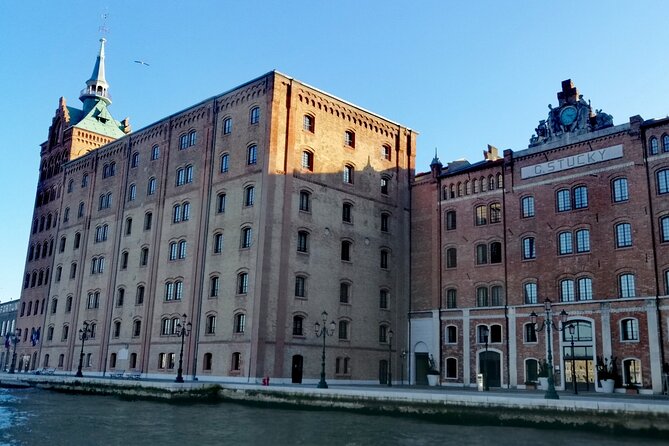
The huge Molino Stucky is one of Giudecca’s most striking buildings. Its Neo-Gothic exterior is hard to miss, with a scale that feels almost out of place beside Venice’s lower, older structures.
The building once housed a flour mill supplied by boats crossing the lagoon. It later operated as a pasta factory. Today, the former industrial complex houses the Hilton Molino Stucky Venice, a five-star hotel.
This is one of the clearest examples of the tour’s main theme. A building made for production has become a place for accommodation and tourism. You do not enter the hotel as part of the walking tour, but seeing it from outside lets you understand how Giudecca’s industrial past remains part of its present identity.
For me, this stop is most valuable when you pay attention to the relationship between water and work. The lagoon was not merely scenery. It was the transport system that brought in raw material and carried finished goods away.
The quieter lanes near Fondamenta de le Convertite
The walk then moves into a less polished part of Giudecca, near Fondamenta de le Convertite. Here, you pass an organic prison market beside a women’s correctional facility.
This is an unusual stop, and it helps keep the tour grounded in present-day life. Venice is often sold through churches, palaces, masks, and cafés. Giudecca offers a more complicated picture, with correctional institutions and community activity close to the visitor route.
The area also shows why this tour is not simply a photo walk. You are asked to notice how the island functions, not just how it looks. The setting may feel modest compared with central Venice, but that is part of its appeal. If you want grand interiors at every stop, this may not be the right experience. If you like seeing the working side of a famous city, it is a strong section of the walk.
A different way to spend a morning on the water:
- Venice: Grand Canal by Gondola with Live Commentary
★ 4.1 · 13,681 reviews - Venice: La Fenice Opera House Entry Ticket with Audio Guide
★ 4.6 · 11,742 reviews - Doge’s Palace & St. Mark’s Basilica with Terrace Access Tour
★ 4.7 · 10,697 reviews - Venice: Burano, Torcello & Murano Boat Tour w/Glassblowing
★ 4.4 · 10,245 reviews
A former monastery turned artists’ center
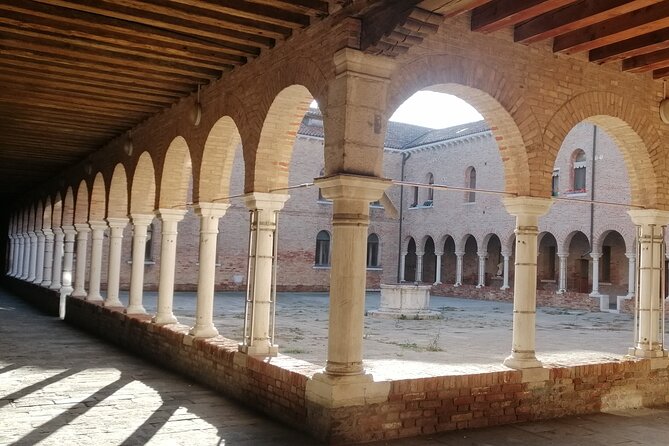
At the former Convento Santissimi Cosma e Damiano, you enter a monastery now used as a center for local artists and artisans. The space links Giudecca’s religious past with its emerging creative scene.
The change of use is important. Instead of treating the old building as a frozen monument, the tour presents it as a place with a second life. Artists and craftspeople now work in a setting that once served a religious community.
Access to working or creative spaces is one of the reasons to book a guided walk rather than explore Giudecca without preparation. The island has no shortage of attractive facades, but you might pass right by the former monastery without knowing what happens inside. The guide provides the context and points out the significance of spaces that are easy to miss.
Teatro Junghans and the reuse of a glass factory
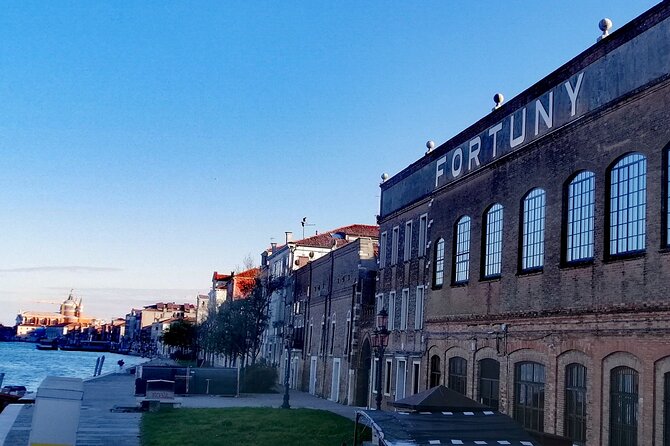
At Teatro Junghans, you see another industrial conversion. A former glass factory has been transformed into a modern residential neighborhood and a contemporary theater facing the southern lagoon.
This stop makes the island’s redevelopment feel current. The story is not only about old buildings being preserved. It is also about former work sites becoming homes and cultural venues.
The theater’s position beside the water adds to the appeal, but the wider lesson is more useful. Venice has limited space, and Giudecca has had to find new purposes for large structures that no longer serve their original industries. The result is a district where old walls and newer uses sit close together.
Palladio’s Redentore and Venice’s annual pilgrimage
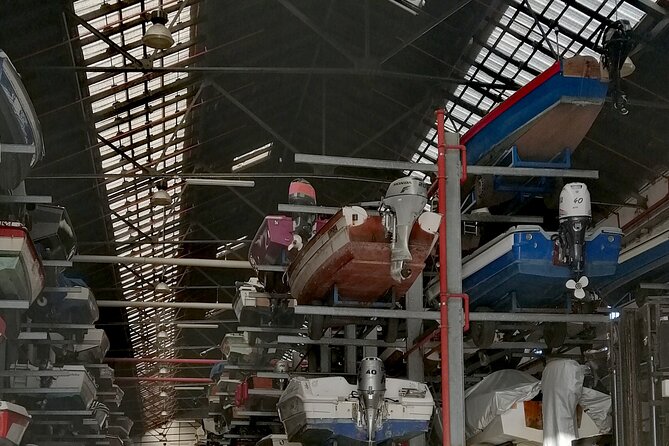
The Chiesa del Santissimo Redentore is the tour’s major architectural stop. Andrea Palladio designed the church as a thanksgiving offering after Venice survived the plague.
The building also carries a living tradition. Every July, Venetians make a pilgrimage across the canal to the church using a temporary pontoon bridge from the Zattere. The bridge has been part of that tradition since 1578.
This is the point where Giudecca’s position across the water becomes central to the story. The canal is both a boundary and a route. It separates the church from the main city, yet once a year it is crossed in a highly visible act of thanks.
The church is important enough to attract people who are primarily interested in architecture, but the tour does not stop there. The guide connects Palladio’s design to the city’s fear of disease and its habit of marking survival through public ceremony. In a tidal city where conditions can change quickly, that sense of gratitude still carries weight.
Villa Heriot and a quieter view of the lagoon
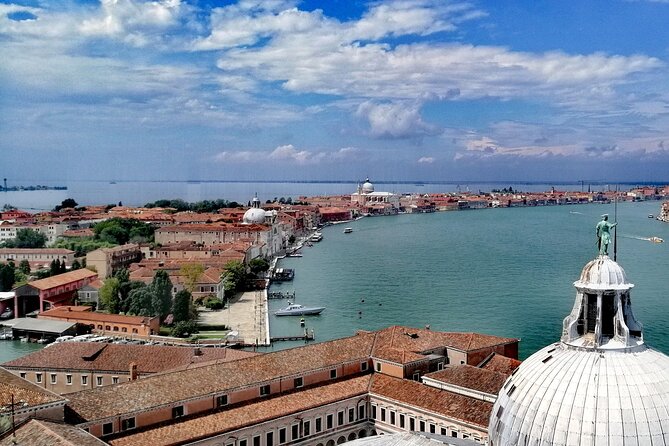
Villa Heriot takes you away from the busiest parts of the island and into an Art Nouveau villa. The villa is described as being off the usual path, with views over the southern lagoon.
The appeal here is less about a famous name and more about atmosphere and position. You see a refined residential side of Giudecca, away from the large hotel and industrial buildings. The lagoon views also give the walk a pause after several history-heavy stops.
This is a good place to remember that Giudecca is not one single neighborhood. Its character shifts from church to factory, from correctional facility to artists’ center, from modern housing to villa. The changing scenery is one reason the walk feels broader than a standard monument tour, even though it lasts only about two hours.
The Casa dei Tre Oci area and the final view
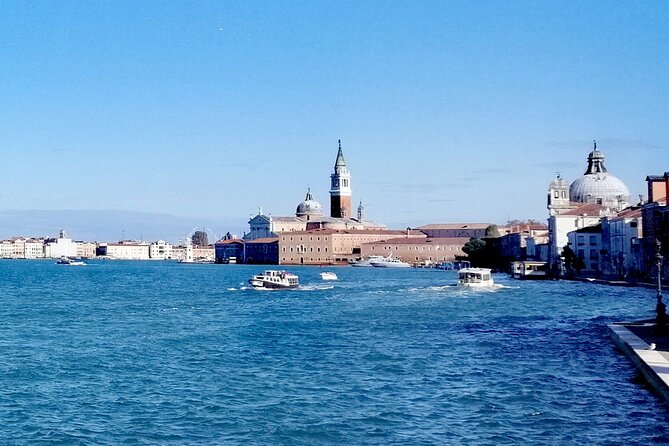
The walk ends near the Casa dei Tre Oci, a palace known for its distinctive Neo-Gothic brick facade and three unusual arched windows. The building provides a strong final image, but the view is the real reward.
From this part of Giudecca, you look toward San Marco and Punta della Salute. After spending the walk on the quieter side of the water, the famous skyline appears from a fresh angle. You finish near the Le Zitelle water bus stop on Fondamenta Zitelle, 33.
That ending is practical as well as scenic. You are not left in an unfamiliar corner with no clear way back. The walk concludes at a transport point, so you can continue around Venice by water bus.
What the $163.64 price really buys you
At $163.64 per person, this is not a bargain walking tour. The water bus ticket is not included, and the tour lasts approximately two hours. If you judge the price by minutes or by the number of interiors you enter, it may feel steep.
The value is in the specialist route and the small scale. You are paying for someone to explain why Giudecca developed as it did, identify former industrial sites, introduce the island’s art spaces, and make sense of places that do not announce their importance. A group capped at 10 also allows for questions that would be difficult on a large city tour.
The tour has a 4.9 rating from 15 ratings and is recommended by 100 percent of the listed participants. The strongest praise centers on Valerio’s humor, local knowledge, clear communication, and ability to involve families and children. Several people returned to Venice many times before discovering Giudecca, which tells you something about the island’s low profile.
Still, price-sensitive visitors should think carefully. If you already know Giudecca well, or if your main goal is an inexpensive stroll, you may prefer to explore on your own. If you want a guide to interpret the island’s unusual buildings and changing social role, the cost is easier to defend.
Timing, meeting point, and practical details
The advertised duration is about two hours. The route lists nine stops, with roughly 15 minutes associated with each one. Those stop times add up to longer than two hours, so you should treat them as approximate and expect some stops to be brief. If timing matters for a reservation afterward, leave extra room.
You meet at Zattere, Venice, and travel to Giudecca by water bus. The ticket is purchased on board and is not part of the tour price. The walk ends at the Le Zitelle water bus stop, giving you a clear point for continuing your day.
A mobile ticket is available, and confirmation is provided when you book. Service animals are allowed, the route is near public transportation, and most people can participate. On certain dates, day visitors staying outside Venice may also need to pay a €5 city access fee. Check the official Venice access information before your visit, since the fee does not apply every day and exemptions may exist.
You can cancel for a full refund up to 24 hours before the start time. Cancellations or changes made within 24 hours are not accepted for a refund.
Who will enjoy this Giudecca walk
I would choose this tour if you have already seen the main sights of central Venice and want a different angle. It also suits repeat visitors who have crossed past Giudecca by vaporetto but never explored the island itself.
Families may find the mix of churches, factories, artists, and unusual local stories easier to follow than a long sequence of formal art lectures. The guide has also been praised for keeping children involved.
Architecture fans will appreciate Sant’Eufemia, Palladio’s Redentore, the Molino Stucky, Villa Heriot, and Casa dei Tre Oci. Visitors interested in urban change will get even more from the route, since nearly every section shows an old building with a new use.
I would hesitate to book it if your Venice schedule is already packed with major museums and churches, or if $163.64 feels too high for a short walk. Giudecca rewards curiosity more than checklist sightseeing.
Should you book the Giudecca Island Discovery Tour?
Book it if you want to understand a less-seen part of Venice and value a local guide who can explain the island’s odd turns, from banished aristocrats to flour mills, prisons, artists’ studios, and Palladian architecture. The small group, unusual route, and final lagoon views give it a clear identity.
Skip it if you want a low-cost tour, a long visit inside major monuments, or a full-day excursion. For the right visitor, Giudecca is one of the smartest ways to see Venice beyond the central crowds. Just budget for the separate water bus fare and confirm the timing before booking another activity.
FAQ
How long does the Giudecca Island Discovery Tour last?
The tour lasts approximately two hours.
Where does the tour begin?
It begins at Zattere in Venice, in the Metropolitan City of Venice.
Where does the tour end?
The walk ends at the Le Zitelle water bus stop on Fondamenta Zitelle, 33.
Is the water bus ticket included?
No. The water bus ticket to Giudecca is not included and will be purchased on board.
How many people can join the tour?
The maximum group size is 10 people.
Who leads the tour?
The experience includes a tour leader and nature and interpretive guide. Guides named in the supplied information include Valerio and Genny.
Can I cancel for a full refund?
Yes. You can cancel at least 24 hours before the experience start time for a full refund. Cancellations or changes made less than 24 hours before the start time are not accepted for a refund.
Recently added around Venice
- Your evening in Venice – Legends&Ghosts&Aperitif★ 4.7 · 79 reviews
- Venice: City Tour & Skip the Line for St. Mark’s Basilica★ 4.1 · 84 reviews
- Walking Tour to Uncover the Hidden Venice★ 4.4 · 34 reviews
- Wine Tasting in Venice★ 4.6 · 42 reviews
- Venice: Watercolor Painting Class at the Prisons Palace★ 4.7 · 27 reviews
- VIRTUAL MUSEUM: Creature di Gomma – Venice Vintage Toys★ 4.7 · 3 reviews
- Venice: Walking Tour & Gondola Ride★ 4.4 · 22 reviews
- Venice Walking Tour from St. Mark’s to Rialto Bridge★ 4.5 · 12 reviews
Tours, compared.
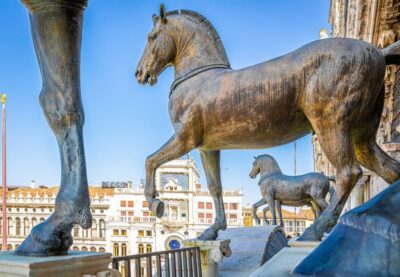
Doge’s Palace & St. Mark’s Basilica with Terrace Access Tour
Read our review →
Burano, Torcello & Murano Boat Tour w/Glassblowing
Read our review →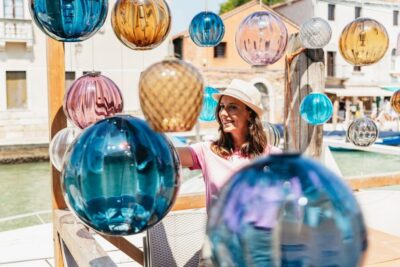
Murano and Burano Boat Tour with Glass Factory Visit
Read our review →
Murano, Burano and Torcello Half-Day Sightseeing Tour
Read our review →
Murano & Burano Islands Guided Small-Group Tour by Private Boat
Read our review →
Murano & Burano Panoramic Boat Tour w/ Glassblowing
Read our review →