Reviewed · TICKETS
Venice: Ticket to Scuola Grande San Giovanni Evangelista
The most rewarding part of this visit is its sense of discovery. The Scuola Grande San Giovanni Evangelista is one of Venice’s oldest lay brotherhood buildings, yet it sits outside the city’s best-known sightseeing circuit. Inside, you move from the Gothic Columns Hall to a grand Renaissance staircase, then into rooms filled with religious art and Baroque decoration. Mauro Codussi’s staircase is a highlight in its own right.
I like two things here in particular: the chance to see Domenico Tintoretto and Giandomenico Tiepolo in a quieter setting, and the remarkable relic of the True Cross, which dates to 1369. The building also gives you a useful look at how faith, charity, art, and civic life once worked together in Venice.
The main consideration is that this is an unguided visit. You receive entry to the building, but not a personal explanation from a guide, so you will get more from it if you take your time and read the available information as you go.
Key points at a glance
- A scuola founded in 1261: Visit Venice’s second-oldest lay brotherhood, with about 800 years of religious and civic history.
- Codussi’s 1498 staircase: Ascend a monumental Renaissance staircase designed by Mauro Codussi.
- Gothic and Baroque rooms: See the Gothic Columns Hall, Chapter Hall, and Oratory Hall in one compact visit.
- Works by major Venetian painters: Look for art by Domenico Tintoretto, Giandomenico Tiepolo, and Jacopo Marieschi.
- The 1369 True Cross relic: See the object connected with the Cycle on the Miracles of the Cross.
- Low-cost cultural stop: At $9 per person, this is an easy addition to a Venice day, especially for art and church-history fans.
Why this old scuola deserves your time
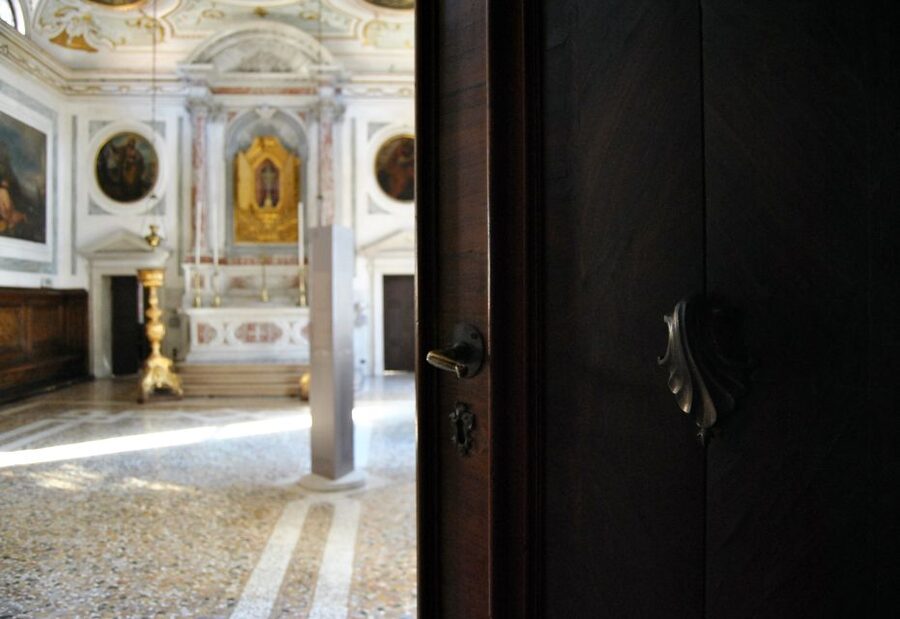
Venice is full of grand churches and famous palaces. That can make it easy to miss places that explain how ordinary religious and civic life once operated. The Scuola Grande San Giovanni Evangelista offers that missing piece.
A scuola was a lay brotherhood, not simply a school in the modern sense. Members joined for religious devotion, mutual support, charity, and public service. The Scuola Grande San Giovanni Evangelista was founded in 1261 and is described as the second-oldest scuola in Venice. That long span gives the building an unusual mix of styles. You are not looking at one clean architectural period. You are seeing centuries of additions and artistic ambition layered together.
I find that useful because the building helps you read Venice in a wider way. The city’s art was not made only for doges and wealthy merchants. Brotherhoods also commissioned grand spaces, sponsored paintings, cared for relics, and shaped public religious life.
The visit is compact enough to fit between major sights, but it is not a quick glance-and-go attraction. Give yourself enough time to look upward, notice the marble work, and compare the building’s Gothic structure with its later Renaissance and Baroque additions.
A few more Venice outings worth comparing
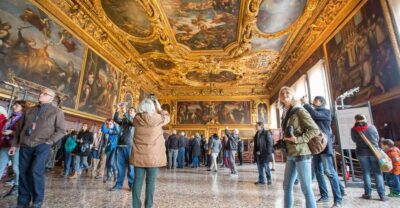
- Venice: Doge’s Palace Reserved Entry Ticket
★ 4.6 · 42,716 reviews - Venice: La Fenice Opera House Entry Ticket with Audio Guide
★ 4.6 · 11,742 reviews - Venice: Leonardo Da Vinci Museum Entrance Ticket
★ 4.5 · 3,560 reviews
Entering through the marble septum
Your visit begins by showing your ticket at the Scuola Grande San Giovanni Evangelista di Venezia. The ticket is valid for one day, and the experience is designed as an independent visit rather than a guided tour.
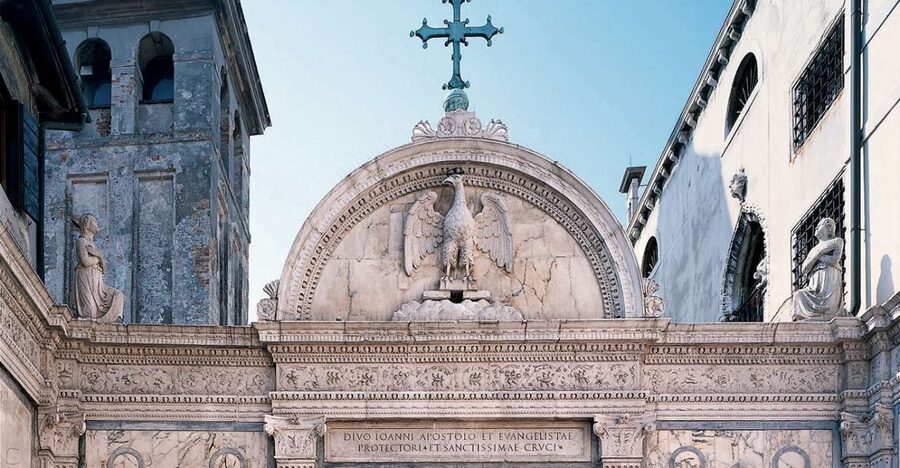
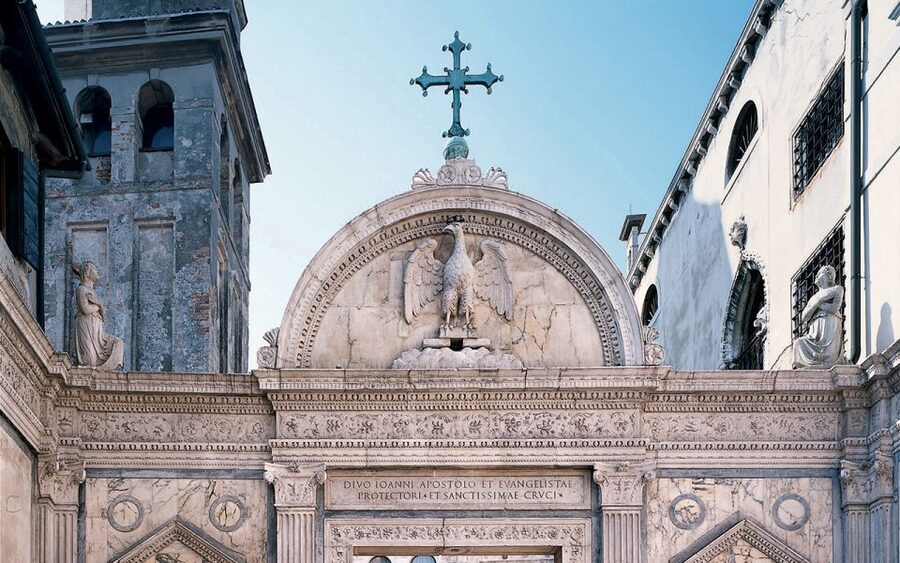
One of the first features to look for is the extraordinary marble septum. This architectural screen helps mark the transition into the main interior and gives the entrance a ceremonial feel. It is a fitting introduction to a building created for formal gatherings, religious observance, and the public display of brotherhood life.
A useful tip is to resist rushing straight toward the paintings. The marble work, columns, and proportions tell you how the building was meant to be experienced. The entrance is not just a passageway. It prepares you for a sequence of increasingly grand rooms.
Because there is no guide included, I would take a moment here to get your bearings. Notice how the building controls movement from one space to the next. The route itself is part of the story.
The Gothic Columns Hall and its public purpose
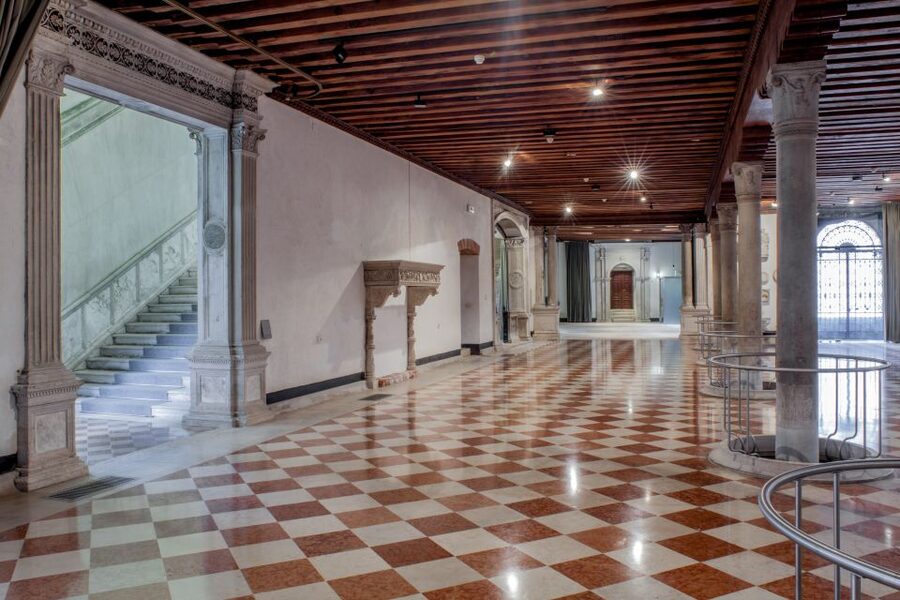
The Gothic Columns Hall was intended for welcoming assemblies of brothers and pilgrims. That purpose matters. It was not a private chapel hidden away from public life. It was a room where people gathered, arrived, waited, and took part in the visible work of the brotherhood.
The hall’s Gothic columns give the room its strongest character. They create a sense of rhythm and support while also showing the early architectural identity of the scuola. Compared with the later rooms, this space feels more structural and restrained.
I like this stop because it makes the institution easier to understand. You can picture the building as a working religious association, not merely a container for art. The hall connected the scuola with its members and with people seeking help, welcome, or religious contact.
If your main interest is famous paintings, this room may seem less dramatic at first. Give it a few minutes anyway. The contrast between the Gothic hall and the Renaissance staircase that follows is one of the visit’s best lessons in Venetian design.
Climbing Mauro Codussi’s Renaissance staircase
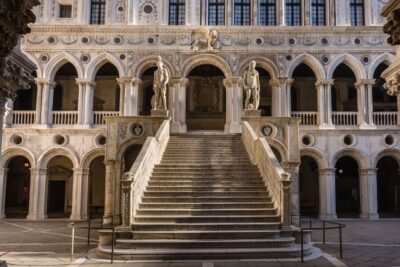
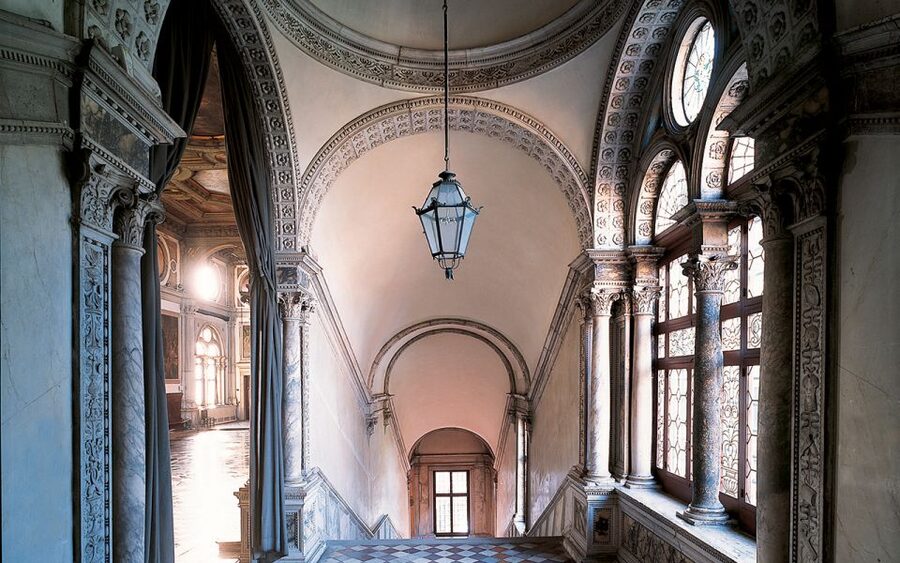
The staircase added in 1498 by Mauro Codussi is one of the clearest highlights. It gives the visit a physical sense of progression. You do not simply pass through rooms in a flat sequence. You ascend into a more formal part of the scuola.
Codussi was an important Renaissance architect, and the staircase reflects the period’s interest in order, proportion, and controlled grandeur. Its monumental quality would have helped turn a simple change of level into a ceremonial movement toward the upper halls.
I would pause on the staircase rather than treating it as a passage. Look at how it changes your view of the building. The Gothic Columns Hall belongs to an earlier visual language, while the staircase introduces a more deliberate Renaissance style.
The supplied information does not specify accessibility arrangements or the exact number of steps. If stairs are a concern for you, check with the venue before booking. The route specifically includes ascending this staircase, so it is an important practical point.
A different way to spend a morning on the water:
- Venice: Grand Canal Gondola Ride with App Commentary
★ 4.1 · 18,908 reviews - Boat Trip: Glimpse of Murano, Torcello & Burano Islands
★ 4.3 · 15,699 reviews - Venice: Grand Canal by Gondola with Live Commentary
★ 4.1 · 13,681 reviews - Doge’s Palace & St. Mark’s Basilica with Terrace Access Tour
★ 4.7 · 10,697 reviews
The Chapter Hall and its Venetian paintings
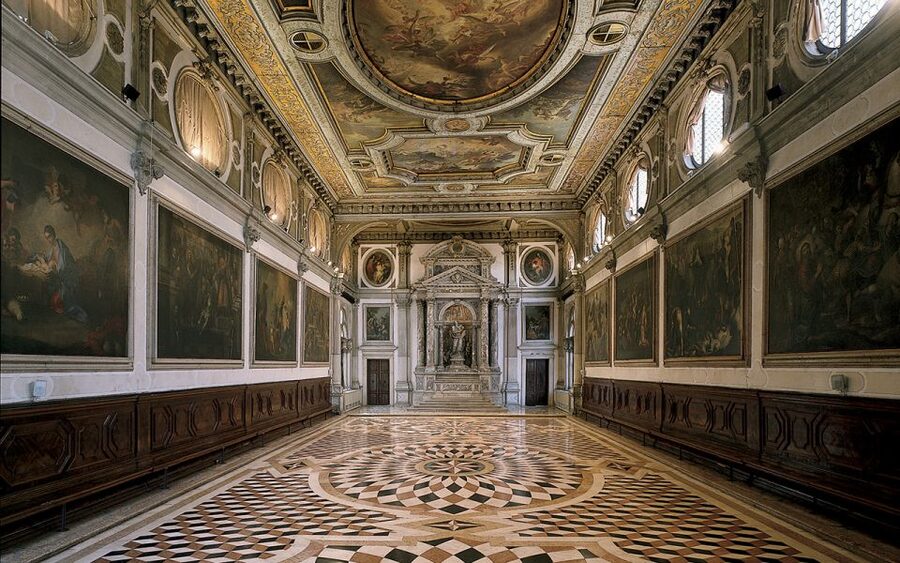
At the top, the route continues to the Chapter Hall. This is where the building’s Baroque splendor becomes most apparent, with works connected to Domenico Tintoretto, Giandomenico Tiepolo, and Jacopo Marieschi.
Domenico Tintoretto was the son of the better-known Jacopo Tintoretto, and his work belongs to the strong Venetian painting tradition associated with dramatic religious scenes and expressive figures. Giandomenico Tiepolo brings a later eighteenth-century sensibility, while Jacopo Marieschi adds another chapter to the city’s long painting tradition.
The value here is not just the presence of recognizable names. The paintings belong to the room and its religious purpose. You are seeing art made for a functioning brotherhood, not a random gallery arrangement. The setting gives the works a different weight.
The Chapter Hall is also a good place to slow down and compare periods. Look for shifts in color, movement, composition, and mood. The building’s Gothic origins, Renaissance alterations, and Baroque decoration are easier to grasp when you see them in sequence.
One limitation is that the visit does not include a guide. If you want detailed commentary on individual paintings, you may need to prepare beforehand or rely on the information available inside. For many people, that tradeoff is fair at $9, but art specialists may want more interpretation.
The Oratory Hall and the 1369 True Cross relic
The Oratory Hall contains the visit’s most important religious object, the relic of the True Cross, dating from 1369. This relic inspired the Cycle on the Miracles of the Cross, linking the physical object to a larger body of religious art and storytelling.
The relic is significant because it shows how devotional objects shaped the decoration and identity of Venetian brotherhoods. The art was not created in isolation. It grew around a sacred object that members believed had direct religious meaning.
Even if you are not especially interested in relics, the Oratory Hall gives you a clear sense of how faith guided the building’s design. The room was meant to focus attention, encourage devotion, and connect painted scenes with a physical object at the center of worship.
I would save extra time for this room. It is easy to spend most of your attention on the staircase and the famous painters, then move too quickly past the relic. The connection between the relic and the Cycle on the Miracles of the Cross is one of the most distinctive facts about the site.
What the changing styles tell you
The Scuola Grande San Giovanni Evangelista works best when you view it as a timeline. Its Gothic elements point to the early centuries of the brotherhood. Codussi’s staircase marks a Renaissance update. The Chapter Hall and Oratory Hall bring in the decorative richness of later Venetian painting.
That mixture may appeal to you more than a perfectly unified building. You can watch Venice change through the architecture itself. The style shifts are not a problem to overlook. They are the main lesson.
The building also shows how religious institutions remained important across many generations. A scuola founded in 1261 continued to adapt its spaces, commission art, and preserve sacred objects. You do not need a specialist’s background to appreciate that continuity. The rooms make it visible.
For first-time visitors to Venice, this is a useful counterpoint to the city’s grandest landmarks. It does not replace St. Mark’s Basilica, the Doge’s Palace, or the Accademia. Instead, it adds a smaller-scale experience that explains the social and religious world behind much of Venetian art.
Is $9 a fair price?
At $9 per person, this is a strong-value ticket for anyone interested in art, architecture, or religious history. You receive access to several significant rooms, a major Renaissance staircase, works by important Venetian painters, and the True Cross relic.
The value is especially good if you are already spending time in central Venice and want an indoor stop that does not demand a full morning. The ticket is valid for one day, so you have some flexibility around your schedule. Check availability for the starting times when booking.
The price also keeps the decision simple. You are not committing to an expensive guided package or a long group excursion. You are paying for entry to a historic building and exploring it at your own pace.
The tradeoff is the lack of a guide. A $9 ticket cannot offer the same depth as a private historian-led visit. If you need detailed explanations of every painting, the experience may feel spare. If you enjoy looking carefully and building your own understanding, the low price works in its favor.
Who will enjoy this visit most
I would recommend the Scuola Grande San Giovanni Evangelista to:
- Art lovers who want to see Tintoretto, Tiepolo, and Marieschi outside the city’s biggest museums.
- Architecture fans who enjoy comparing Gothic, Renaissance, and Baroque design.
- Visitors who have already seen Venice’s headline sights and want something less familiar.
- People interested in religious history, relics, and the role of lay brotherhoods.
- Repeat visitors looking for a new cultural stop.
- Budget-minded sightseers who want a meaningful $9 experience.
It may be less suitable if you want a lively guided tour, extensive commentary, or a large collection presented like a museum. The experience is centered on the building itself, and you need to bring some curiosity to it.
A particularly good reason to visit is simple: even people who know Venice well can miss this place. One Italian visitor had been to Venice many times and had even lived there for years without seeing it. That says something about how far it sits from the standard sightseeing path.
Practical details before you go
The ticket includes entry to the Scuola Grande San Giovanni Evangelista. A guide is not included. The host or greeter information lists Italian and English, while the activity languages are also Italian and English.
You show your ticket at the scuola itself. No transport is included in the ticket details, so plan your route to the meeting point separately.
You can cancel up to 24 hours in advance for a full refund. The reserve-now, pay-later option lets you hold a place without paying immediately, which is useful if your Venice schedule is still changing.
The published rating is 4.8 from 71 reviews, with especially strong praise for the site’s art, history, faith, courteous welcome, and value as a less-known Venetian stop. The most useful lesson is not to expect a famous blockbuster attraction. Expect a serious, atmospheric historic building that rewards attention.
Should you book the Scuola Grande San Giovanni Evangelista?
Yes, if you want an affordable and independent look at Venice’s art and religious life beyond the usual circuit. The combination of the 1261 foundation, Gothic Columns Hall, Codussi staircase, Baroque paintings, and 1369 True Cross relic gives you plenty to see for $9.
Book it if you enjoy finding context behind famous art. Skip it if you need a guide to explain every room or prefer Venice’s biggest, most immediately spectacular sights.
For most curious visitors, I would add it to a day in the surrounding area. It is inexpensive, culturally substantial, and different enough from the standard Venice checklist to feel worthwhile.
FAQ
Where is the experience located?
The visit takes place at the Scuola Grande San Giovanni Evangelista di Venezia in Veneto, Italy.
How much does admission cost?
The ticket costs $9 per person.
How long is the ticket valid?
The ticket is valid for one day.
Is a guide included?
No. The ticket includes entry to the Scuola Grande San Giovanni Evangelista, but no guide is included.
Which languages are available?
The listed languages are Italian and English. The host or greeter information also lists Italian and English.
What can I see inside the scuola?
You can see the marble septum, Gothic Columns Hall, Mauro Codussi’s Renaissance staircase, the Chapter Hall, the Oratory Hall, paintings by Domenico Tintoretto, Giandomenico Tiepolo, and Jacopo Marieschi, plus the 1369 relic of the True Cross.
Can I cancel the booking?
Yes. You can cancel up to 24 hours in advance for a full refund. A reserve-now, pay-later option is also available.
Recently added around Venice
- Your evening in Venice – Legends&Ghosts&Aperitif★ 4.7 · 79 reviews
- Venice: City Tour & Skip the Line for St. Mark’s Basilica★ 4.1 · 84 reviews
- Walking Tour to Uncover the Hidden Venice★ 4.4 · 34 reviews
- Wine Tasting in Venice★ 4.6 · 42 reviews
- Venice: Walking Tour & Gondola Ride★ 4.4 · 22 reviews
- Venice: Watercolor Painting Class at the Prisons Palace★ 4.7 · 27 reviews
- VIRTUAL MUSEUM: Creature di Gomma – Venice Vintage Toys★ 4.7 · 3 reviews
- Venice Walking Tour from St. Mark’s to Rialto Bridge★ 4.5 · 12 reviews
Tickets, compared.
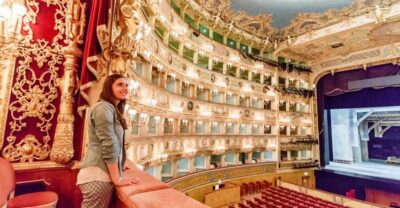
La Fenice Opera House Entry Ticket with Audio Guide
Read our review →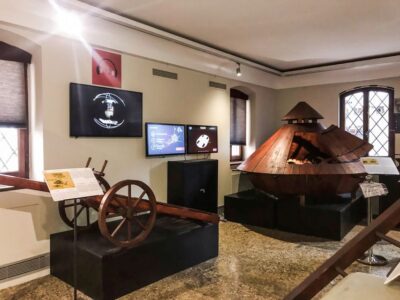
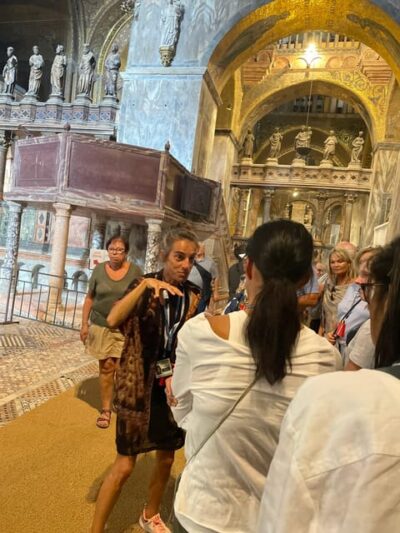
St. Mark’s Basilica & Doge’s Palace Tour with Ticket
Read our review →
Doge’s Palace & St. Mark’s Basilica Tickets + Tour Options
Read our review →