
Reviewed · MUSEUMS
Venice: Entrance Ticket to the Naval Historical Museum
Venice’s Naval Historical Museum gives you a different way to understand the city. Only five minutes from Piazza San Marco, it traces Venice through the boats, weapons, models, paintings, and official papers that supported its power at sea. The collection reaches from ancient Venetian craft to modern Italian Navy vessels, with an unusual group of boats from China and the Far East.
I like the excellent location, since you can fit the museum into a San Marco or Castello walking day without arranging transport. I also like the range of displays, which moves beyond ship models to documents, artwork, and real maritime objects. The main drawback is that this is a self-guided visit, so you need to supply your own context and decide how much time to give each floor.
Key points to know
- Five floors in a 15th-century granary: The museum occupies a former storehouse connected to the naval life of the Venetian Republic.
- A five-minute walk from Piazza San Marco: It is easy to pair with central Venice sightseeing and the Ancient Arsenal.
- Ancient boats meet modern Navy models: The collection covers Venice’s maritime past through to contemporary Italian naval design.
- An unusual Far Eastern collection: Boats from China and other parts of the Far East add a wider view of seafaring traditions.
- About 90 minutes works well: The stated visit length suits a focused museum stop rather than an all-day outing.
- Entry only, with no guide included: You explore at your own pace, using the exhibits themselves as your main source of information.
Why Venice’s Naval Museum matters
Venice is often presented through palaces, churches, canals, and grand squares. Those sights explain how the city looked, but the Naval Historical Museum helps explain how Venice functioned. A lagoon city with no easy access to farmland or overland routes depended heavily on water, shipbuilding, navigation, trade, and military force.
MUNAV, the museum’s commonly used name, is owned by the Italian Navy and managed by the Ministry of Defense. That gives the collection a clear institutional purpose. It is not simply a display of decorative boats. It preserves naval objects and documents connected with the Armed Forces and with Venice’s long maritime tradition.
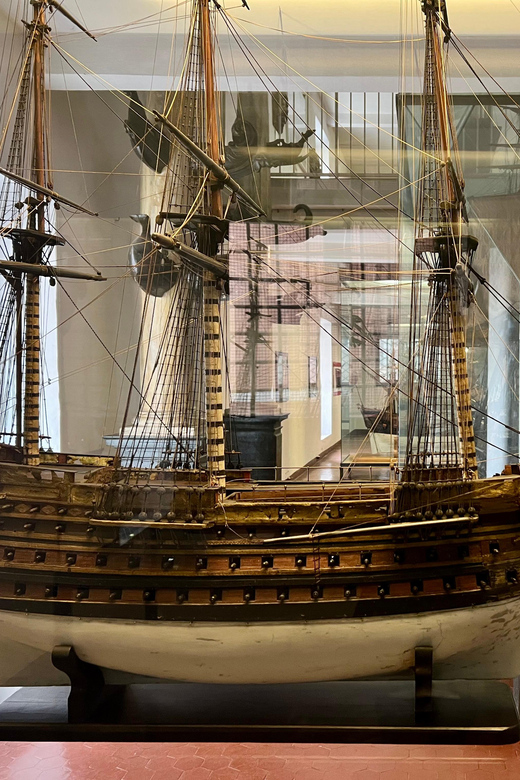
I find that useful because a museum like this can turn an abstract idea into something you can see at close range. A ship model shows scale and design. A painting can show how naval power was presented. A document gives you a more official record of how the state organized and remembered its maritime life.
The museum also reaches beyond the Venetian story. Its boats from China and the Far East provide a welcome change of direction. You are not looking only at one city’s ships. You are also seeing how boatbuilding and seafaring traditions can differ across regions.
More museums and galleries in Venice:
- Venice: Leonardo Da Vinci Museum Entrance Ticket
★ 4.5 · 3,560 reviews - Venice’s Best: Basilica, Doge’s Palace, Gondola & History Gallery
★ 4.5 · 2,478 reviews - Venice: Vivaldi’s Four Seasons Concert & Music Museum Visit
★ 4.8 · 2,065 reviews
A former granary beside the Ancient Arsenal
The museum occupies a 15th-century building that once served as the Granary of the Serenissima Republic. That setting matters. You are viewing naval history inside a building tied to the practical storage and administration that helped Venice operate.
The location is one of the strongest reasons to book. From Piazza San Marco, the walk takes about five minutes, and the museum is adjacent to the Ancient Arsenal of Venice. You can make it an easy addition to a day focused on San Marco, the eastern Castello area, or the Arsenal.
The central location does not mean you should treat the museum as a quick room near the square. The building contains five floors and covers about 6,000 square meters. Even with a planned visit of 1.5 hours, you will need to keep moving if you want a broad look at the collection.
I suggest arriving with a simple plan. Give yourself enough time to see each level, then pause longer in the sections that match your interests. If ship design fascinates you, models may hold your attention for a while. If you care more about state power or visual culture, paintings and documents may deserve more of your time.
What you see during the 90-minute visit
The experience has no listed guided route, so the pace is yours. You receive an entry ticket and move through the museum independently. That makes the visit flexible, but it also means you should not expect a guide to connect every object into one spoken story.
The collection includes historical artifacts, ship models, paintings, and documents. Each type of object does a different job. Models help you understand the shape and construction of vessels. Paintings show how ships and naval events were represented. Documents add a written record to the physical objects.
The first part of your visit can focus on Venice itself. You will see how the city’s naval tradition developed from its early boats and maritime activity. The displays help place Venice in a wider story of trade, defense, transport, and government.
The museum then carries the story into the modern era. Contemporary Italian Navy models show that naval history did not end with the decline of the Venetian Republic. The collection continues into a period when Italy’s Navy developed its own modern identity and technology.
The transition from ancient Venetian craft to modern Italian naval models is one of the most useful parts of the visit. It gives you a timeline rather than a single snapshot. You can compare how vessels changed while remembering that the basic needs of moving people, goods, and weapons across water remained.
The collection of boats from China and the Far East adds another layer. These objects are not just extra decoration. They let you compare different responses to water, distance, materials, and practical travel. The variety should appeal to anyone who likes design, engineering, or cultural history.
Ship models, paintings, and documents
Ship models are likely to attract your eye first, but do not rush past the smaller records. A model can make a naval concept easy to grasp, while a document or painting may explain how that concept fit into Venetian society.
For families, models can provide a clear entry point. You can discuss how vessels were built, what they carried, and why one shape might suit a particular task. The museum is also suitable for anyone who prefers objects over long wall texts, although the amount of information you absorb will depend on how carefully you read each display.
The paintings help connect naval power to public image. Venice did not only build ships and send them out to sea. It also recorded and displayed its maritime identity. Paintings can show the importance attached to ships, ceremonies, victories, and the city’s relationship with water.
Documents offer a quieter side of the story. They remind you that fleets require planning, rules, money, orders, and record keeping. If you want only dramatic objects, these displays may feel less immediate. If you want to understand how a naval system worked, they are important.
Because the visit is self-guided, you can choose your own balance. You might spend ten minutes looking at models, then slow down for paintings and documents. Or you can make a quick pass through the written material and focus on the boats. The museum lets you set that rhythm.
More history tours in Venice:
- Venice: City Center Historical Guided Walking Tour
★ 4.2 · 1,873 reviews - Venice: Bell Tower & St Mark’s Square History Gallery Ticket
★ 4.3 · 910 reviews - Basilica, Doge’s Palace, History Gallery & Bell Tower Option
★ 5.0 · 586 reviews - Venice: Natural History Museum Entry Ticket
★ 4.7 · 312 reviews
The unusual China and Far East collection
The boats from China and the Far East are among the museum’s most distinctive features. They broaden the visit beyond Venice and Italy, giving you a chance to compare boat forms from different maritime cultures in one place.
This section can be especially useful if you have already seen several Venetian palaces and churches and want something less familiar. The Far Eastern collection changes the visual vocabulary of the museum. Instead of seeing one local tradition repeated, you encounter a wider set of ideas about boats and water travel.
The supplied information does not identify every vessel or explain a detailed route through this section, so I would not book expecting a specialist lecture on Chinese or Far Eastern naval history. Think of it as an important comparative part of the collection, not a separate guided exhibition.
That limitation is worth knowing. The museum’s main focus remains Venice and the Italian Navy. Still, the Far Eastern boats give the visit a broader reach and help prevent the displays from feeling narrowly local.
How the museum fits into a Venice day
The museum is easiest to use as a planned stop between major sights. Its five-minute distance from Piazza San Marco makes it convenient after visiting the square and nearby monuments. Its position beside the Ancient Arsenal also makes it a natural choice if you are already walking through the eastern part of the historic center.
The stated duration is 1.5 hours. That is enough for a focused look at the five floors, but not necessarily enough for a slow reading of every document and label. If naval history is a major interest, you may want to allow extra time in your wider schedule, without assuming that a short stop will cover every detail.
I like the museum for this reason: it offers substance without demanding an entire day. Venice has many sights that require advance planning and long queues. This visit can give you a serious look at an important part of the city’s identity while leaving room for canals, churches, and neighborhood walks.
The separate entrance for ticket holders is also useful. The activity includes skip-the-line access through a separate entrance, which can make the arrival smoother during a busy day. It does not mean every part of the museum will be empty, but it removes one possible delay at entry.
Is the $18 ticket good value?
At $18 per person, the ticket is a reasonable purchase if you care about Venice’s maritime past, military collections, shipbuilding, or museum displays with a strong local connection. The price pays for access to a large five-floor institution rather than a small single-room exhibit.
Value depends on how you use the visit. If you spend only a few minutes looking at the largest models, the price may feel less convincing. If you take the full 90 minutes and read across the collection, you get a much fuller picture of Venice than you would from sightseeing around St. Mark’s alone.
The ticket also makes sense for repeat visitors. If you have already seen the city’s famous religious and artistic sights, the Naval Historical Museum offers a different subject without sending you far from the center.
I would be more cautious if you have no interest in boats, military history, or technical displays. The museum’s purpose is specific. It is not a general art museum, and the experience does not include a live guide to make the subject accessible through stories and commentary.
Who will enjoy MUNAV most?
I recommend this museum to several kinds of visitors:
- You enjoy ships, engineering, transport, or military history.
- You want to understand why the sea mattered so much to Venice.
- You prefer a self-guided visit with freedom to set your own pace.
- You are traveling with children who respond well to models and physical objects.
- You have already seen the best-known San Marco sights and want a different subject.
- You are interested in comparing Italian maritime traditions with boats from China and the Far East.
It is less suited to anyone seeking a guided storytelling experience. No guided tour is included, and no guide name is provided for this visit. You will need to read, observe, and make your own connections.
The museum can work for a mixed group, too. One person can focus on paintings and documents while another studies ship models. Since you are not tied to a tour group’s pace, it is easy to separate briefly and meet again.
Small pets are allowed in the rooms and outdoor spaces if they stay in their own carrier or are held for the full visit. Guide dogs for people with visual impairments are exempt from that rule. This is useful to know before you arrive, especially if your sightseeing day includes a pet.
What to know before booking
The experience includes the entry ticket only. It does not include a guided tour, so the booking suits independent museum visits rather than structured instruction.
The duration is listed as 1.5 hours, and you choose from available starting times when booking. The provider is D’Uva. You can cancel up to 24 hours in advance for a full refund, and the reserve now, pay later option lets you hold a place without paying at the time of booking.
The overall rating is 4.7 from 39 reviews, with the clearest praise focused on the museum being informative, appealing to a broad audience, and closely tied to Venetian history. That matches the practical picture: this is a focused, well-located cultural stop with enough variety for different interests.
Do not expect a theatrical presentation or a personal tour. The strength is the collection itself, the historic setting, and the chance to explore without being rushed by a guide.
Should you book the Naval Historical Museum?
Book it if you want to see the working side of Venice, not only its grand façades. The combination of a 15th-century granary, five exhibition floors, Venetian boats, Italian Navy models, paintings, documents, and Far Eastern vessels gives you a useful look at how the city lived through the sea.
At $18, it is a fair value for a 90-minute visit, especially because of its five-minute walk from Piazza San Marco and its position beside the Ancient Arsenal. I would place it high on the list for anyone interested in ships or Venetian state power.
Skip it if your schedule is already packed with art museums and you have no interest in naval subjects. With no guided tour included, the museum asks you to bring your own curiosity. For the right visitor, that independence is a benefit, not a problem.
FAQ
Where is Venice’s Naval Historical Museum located?
MUNAV is in Venice, in the Veneto region of Italy. It is about a five-minute walk from Piazza San Marco and next to the Ancient Arsenal of Venice.
How long does the visit take?
The stated duration is 1.5 hours. Your actual time can vary depending on how closely you study the models, paintings, documents, and other displays.
What does the ticket include?
The ticket includes entry to the Naval Historical Museum. A guided tour is not included.
Can I skip the line?
The ticket provides access through a separate entrance, allowing skip-the-line entry.
How much does admission cost?
The listed price is $18 per person.
What can I see inside the museum?
The museum presents historical artifacts, ship models, paintings, documents, ancient Venetian boats, modern Italian Navy models, and boats from China and the Far East.
Is the museum suitable for a broad audience?
Yes. The collection includes different types of objects and has been described as suitable for a wide audience. Your experience will be self-guided.
Are small pets allowed?
Small pets are allowed if they are carried in their own carrier or held in your arms for the full visit. Guide dogs for people with visual impairments are exempt from this rule.
Recently added around Venice
- Your evening in Venice – Legends&Ghosts&Aperitif★ 4.7 · 79 reviews
- Venice: City Tour & Skip the Line for St. Mark’s Basilica★ 4.1 · 84 reviews
- Walking Tour to Uncover the Hidden Venice★ 4.4 · 34 reviews
- Wine Tasting in Venice★ 4.6 · 42 reviews
- Venice: Walking Tour & Gondola Ride★ 4.4 · 22 reviews
- Venice: Watercolor Painting Class at the Prisons Palace★ 4.7 · 27 reviews
- VIRTUAL MUSEUM: Creature di Gomma – Venice Vintage Toys★ 4.7 · 3 reviews
- Venice Walking Tour from St. Mark’s to Rialto Bridge★ 4.5 · 12 reviews
Museums, compared.
Venice’s Best: Basilica, Doge’s Palace, Gondola & History Gallery
Read our review →
Vivaldi’s Four Seasons Concert & Music Museum Visit
Read our review →
Charming Gondola Ride on the Grand Canal & Gondola Gallery™
Read our review →
Bell Tower & St Mark’s Square History Gallery Ticket
Read our review →
Venice Museum Pass & Doge’s Palace Entrance Ticket
Read our review →
Basilica, Doge’s Palace, History Gallery & Bell Tower Option
Read our review →
Browse the lists this tour appears in